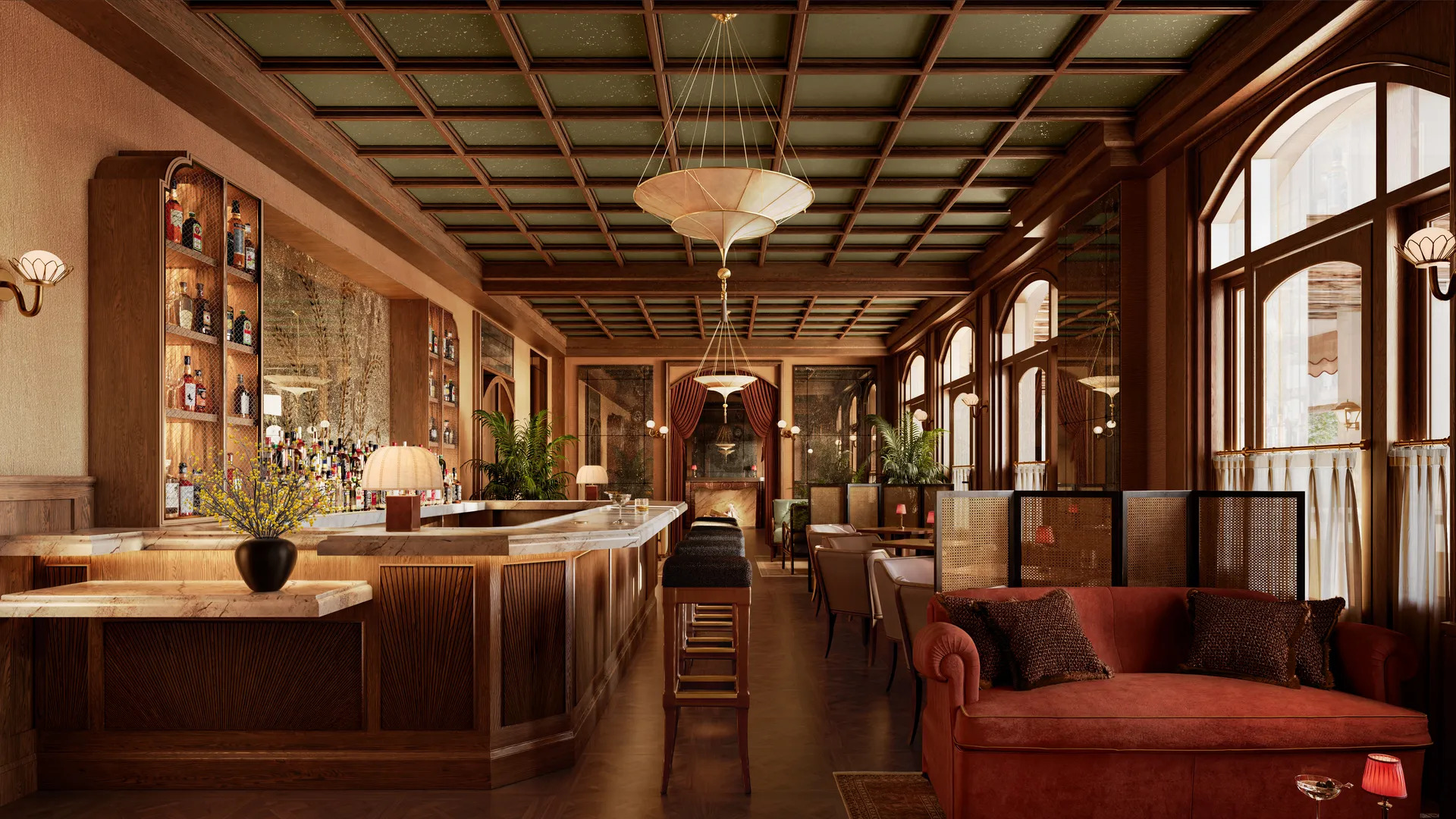
Club culture took off in London in the 18th century, and by the early 20th century, the whole of St. James’s—the swanky area between Piccadilly and Buckingham Palace—was occupied by grand buildings dedicated to the various interests of the great and the good. Collectively known as gentleman’s clubs, these establishments have, amazingly, nearly all survived, and despite archaic and convoluted membership processes, they are very welcoming to any visiting American who has taken the time to join a local university or racquets club. In fact, the red carpet will be rolled out to travelers who happen to have affiliations with clubs in Chicago, Boston, and Philadelphia, to name but a few. There are lots—the Carlton Club, White’s, the Athenaeum, Boodle’s—but my favorite St. James’s club is Brooks’s (I’m a member), as it’s nonpolitical and slightly more casual than some of the others, plus the food is exemplary. They even provide feather pillows so members can nap in the library after lunch.
The Swinging Sixties brought a second club revolution to London, spearheaded by the opening of Annabel’s in 1963. Mark Birley was a visionary who realized that the younger generation was becoming prosperous but didn’t want to sit in fusty rooms smoking cigars. Its success was immediate, and many others adopted the model with varying degrees of success. Birley’s brilliance was in creating spaces where people felt completely at home, and his restaurants Harry’s Bar and Mark’s Club, despite their strict membership criteria, are always very hospitable to Americans who treat them as second homes during the summer season. His son Robin Birley carried on the tradition with the opening of 5 Hertford Street in 2018 and his beautiful restaurant Oswald’s, where members can keep their own wines in dedicated drawers.
The third wave probably began with the Groucho Club in 1985, but it was Nick Jones who created the benchmark with his first Soho House 10 years later. These clubs recognized the success and attitude of a new breed of cultural entrepreneurs and positively rebelled against the formality of the established clubs. Ties were banned as were bankers and anyone else who didn’t exactly fit the zeitgeist. Today there are 10 Soho Houses in London, and, while all are busy, they are nevertheless open to members from around the world. The best one is Soho Mews House in Mayfair, which usually only allows visits from members who have belonged to Soho House years. Many others have jumped onto the bandwagon, and clubs such as the Arts Club, Maison Estelle, the House of Koko, and the Roof Gardens have had to distinguish themselves by increasingly opulent decor and extravagant facilities, sometimes at odds with the informality of their members. There is something for everyone, and given the competition, the memberships are easy to obtain if you fit the mold.
If none of these appeal, there are a slew of new clubs in London, including Town Hall in King’s Cross, the Pembroke in Belgravia, and 16 Charles Street in Mayfair. All enjoy huge budgets and lavish facilities to ensure their numbers feel they have landed into their own particular dream home.
The new wave of London clubs always had a very urban quality, but inevitably, as their members matured, so did their needs. Soho House was the first to recognize this with the opening of its Somerset outpost Babington House in 1998, but more recent clubs such as Soho Farmhouse, the Newt, and Manor Estelle redefined the weekend away. All-night bars pumping out house music are now but a stone’s throw from daycares, adventure playgrounds, and early morning yoga sessions.
Money, charm, and influence will always help bend membership rules, but there is one club where it is nigh impossible to get in. The Hurlingham Club in southwest London has the extraordinary benefit of 42 acres of manicured gardens in the heart of the city and is so exclusive that it has permanently closed its membership to all but the children of existing members. No amount of fame, fortune, and power can gain you admittance, but I always advocate a novel approach: Perhaps you can suggest sponsoring a new wing?
Inevitably, our club culture has begun to be exported, and Soho House has been remarkably successful in launching outposts around the globe, while Robin Birley has completely reenergized New York’s Upper East Side with the opening of Maxime’s. Soon, Annabel’s will also debut a sister club in the Meatpacking District, and it is only a matter of time before Palm Beach is invaded by clubs offering an English sensibility. That said, their relative scarcity means that initiation and membership fees are a multiple of those charged at home.
The English love Americans. They admire their success, wealth, and energy, and they are delighted to welcome them to the enclaves that have been so assiduous about keeping others out. It may require a little research or a phone call here and there, but if you want to scratch beneath the surface of this great city, you would do well to join the English in their safe havens and enjoy their hospitality.